Day One: designing for the officer who is present at both ends.
Eight weeks on a reintegration service for someone released without a phone. Four interviews broke the concept; a three-pass regulatory audit rebuilt the system behind it.
About 6,216 people walk out every year, and almost nothing is built for the week after.
Holding one person for a year runs to roughly $150,505, and the seventy-two hours after release decide an enormous amount.
For about 625 days somebody tells these people where to be. On the last morning it stops at once.
We began with the obvious response: they walk out with the first week already on their phone, the premise most reentry technology is built on.
No phone, an air-gapped network, and research from the wrong country.
Each is small. Together they end every version of a service that reaches the person after the gate.
Nobody is released with a phone. No device, no number, no account. Every assumption about reaching the person after release fails on that sentence.
Institutional IT is air gapped. A deliberate security posture, not a procurement gap waiting to be fixed.
The American evidence does not transfer. Published reentry research describes a privatized system where Canada's is public.
I took the system behind the tool, and the argument for funding it.
Three of us worked in parallel for eight weeks on one shared research document.
- I mapped where an officer's information comes from
- I audited the hypothesis against the Privacy Act, the CCRA, sixteen commissioner's directives and Treasury Board policy
- I specified the assistive-AI field map and its refusals
- I wrote the cost case
- Natashi Sills built the dashboard; Yuki Shi the app and the card
The person could not be reached. Somebody crosses that wall every day.
The institutional parole officer follows a case from intake to release, and sits inside the air gap by employment.
So the project moved its subject. The named persona gave way to two archetypes, because a name and a face invite a reader to picture one officer instead of 1,272.
Hestia
I am the one who stays. I keep the fire while everyone else rotates out.
Institutional parole officers: the only role that follows a person from intake to the gate, over the caseload cap, with a planning window collapsed from six months to one.
what the tool owes Hestia
Give the unmandated work a form, so it stops losing to the work that has one. Pre-fill from verified fields and leave her the judgement. Then close the loop: show her it landed.
the evidence behind this archetype
carries
where this archetype sits
friction
Nostos
I walked out with a bag and a bus ticket, and the plan stayed inside.
People released from federal institutions: about 6,216 a year, most serving four years or less, most inside roughly 625 days.
what the tool owes Nostos
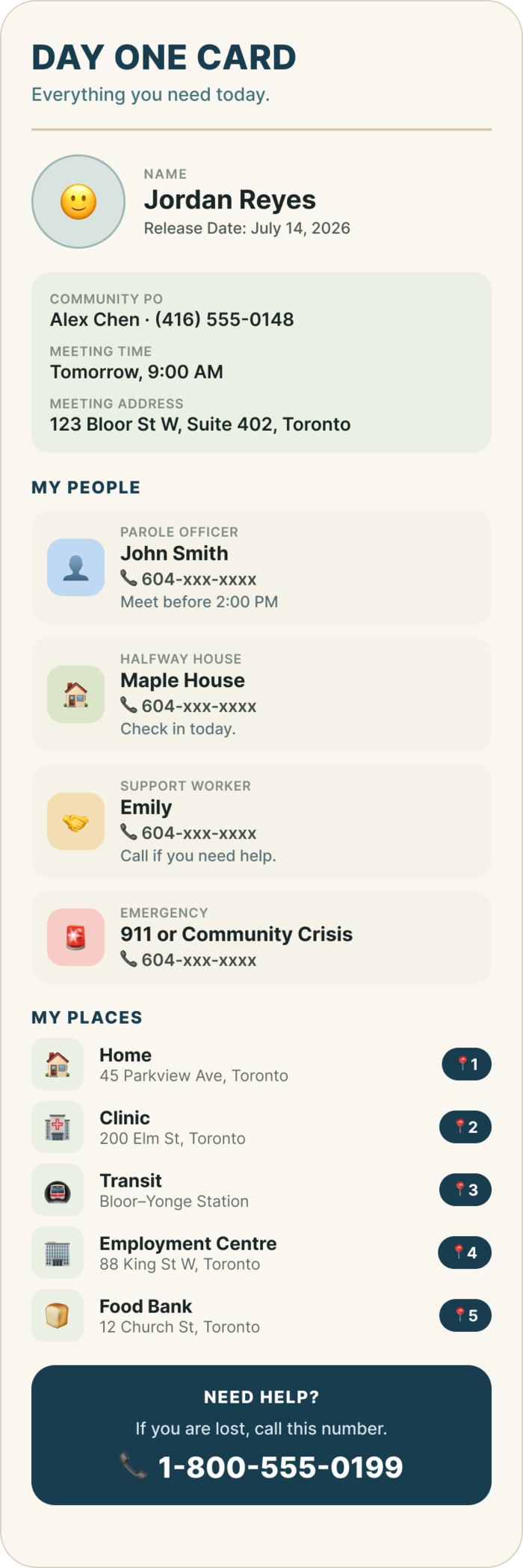
Something that crosses with him needing no battery, no signal, no account. If it cannot be printed and held, it does not reach him. This produced the Day One Card.
the evidence behind this archetype
carries
where this archetype sits
friction
What has a form gets done, so we gave this work one.
A record has a template, a deadline, and somebody who notices when it is late. Release planning has none.
The two activities that most decide whether a release holds are neither mandated nor productive of an artifact, so they lose to work that leaves a trace.
That is structural, not motivational, which is what tells you what to build. Give it a form and it competes.
→ scroll the map sideways on a narrow screen
The five jobs in full 1 table
| the job | stated in full |
|---|---|
| identification, in one pass | When a case approaches statutory release, complete every identification application together, so the documents exist well before release day and not the afternoon before it. |
| placement without the phone tree | When placing someone in treatment or housing, have every facility's rules and intake process in one place, so the officer stops telephoning agencies one at a time to ask questions they have asked before. |
| planning measured in hours | When the caseload runs past capacity, make release planning a job of hours instead of weeks, so it stops losing every week to the work that is mandated. |
| support that outlasts the gate | When someone walks out, keep enough structure around them that the first week has a shape, so release day is not a drop from full support to none. |
| the plan survives the transfer | When a case moves to a community parole officer, move the plan and its context intact, so months of preparation are not rebuilt from a file. |
The brief asked for two confidence buckets. I shipped three.
Collapsing inferred into guessed overstates the uncertainty. Collapsing it into verified is a lie.
Twenty nodes and twenty-one edges, with line style carrying confidence so a reviewer needs no legend lookup.
Then the notation earned itself. The only dotted edge with an empty governing-rule column carries the community officer's reporting instructions to the person. It exists on the word of two practitioners.
| id | flow | governing rule |
|---|---|---|
| E19 | officer to community officer: shared national record, documented pre-release case conference | CD 712-4, 715-1 |
| E20 | community officer to officer: reporting instructions and conditions, printed onto the release certificate | nothing on record |
| E13 | officer to the person: disclosure package, decision information, release certificate | CCRA s.27, Privacy Act s.12 |
The notation and the failure modes 3 figures
the whiteboard hypothesis
a hub that decidesNothing here keeps the health record apart, nothing traces a claim back to what it rested on, and nobody is named as deciding.
after three regulatory passes
three lanes, and people at the end of themlate
Intake has a ninety-day window and the intake officer about four days to file. Court, police, and record checks arrive weeks later, so the first plan is built on information taken at face value.
siloed
Health and psychological information sits in a separate system under its own directive, in its own information banks. It cannot pool into a general store.
no channel
No directory of facility rules exists, so placement runs on the telephone. Drawn below.
nothing portable
The plan and the handoff leave no artifact that survives the gate. On release day the structure stops and nothing goes with the person.
→ scroll the fan sideways on a narrow screen
Three passes against the regulations rewrote the design.
Constraint-first rather than ideation-first: the directives settled more design questions than a workshop could have.
A rule tells you which of your options were never available.
system of record
Sentence, offence, classification, plan. Intake data reused for release planning under consistent use.
health, held separately
Own store, own directive, own information banks. Reaches the officer as a clinical summary through the health team, with consent.
the person
An explicit source, not only a recipient. Co-develops the plan, so the arrow runs both ways.
the assistant · contained, read-mostly
Runs inside the boundary. No external or commercial model, no training on offender data, no free-text generation. Deterministic pre-fill from fields already verified, every value showing the field it came from.
the officer recommends
Author of record. Signs every high-stakes action, and the trail says so.
the board decides
Accountability stays with people. An automated-decision assessment would gate any of this running.
the handoff package
One package the community officer opens rather than rebuilds.
a provisioned device
If an app exists, the service hands over the device at release, holding only the person's own information. Everything else stays behind the wall.
a printed card
No battery, no signal, nothing to log into. The only part of the system that physically goes out the gate.
- The merged database splits in two. The whiteboard drew one store the assistant reads across everything, psychology included. Health information is held separately under its own directive and cannot pool into a general store, so the clinical summary now reaches the officer through the health team instead.
- "100% no input into AI" was refused as written. That is the whiteboard's own phrase, and read literally it is self-defeating, because an assistant given no case data cannot help anybody. I kept the intent and dropped the letter: nothing leaves the boundary, no external model, no training on offender data. This is the correction I would defend hardest, because it argues against an instruction the team wrote for itself.
- The assistant stops being a hub that decides. The hypothesis drew it as a processing hub feeding decisions. The board decides and the officer recommends, so accountability stays with people and an algorithmic impact assessment would be a condition of running any of it.
- The release-day phone becomes a provisioned device. Nobody is released with a phone. For an app to exist at all, the service has to hand over hardware at release, carrying only the person's own plan, identification, reporting instructions, and officer contact.
- The person is added as a contributor. The hypothesis had them as a recipient only. They are an explicit source in statute and they co-develop the plan, so the corrected map draws that arrow in both directions.
→ scroll the boundary sideways on a narrow screen
I removed the opportunity to fabricate rather than checking for it.
The problem is not that a drafting assistant might be wrong. It is what being wrong means here.
A fabricated sentence in an assessment that reaches the Parole Board is disqualifying, and one instance would end a pilot. The usual mitigation is review on top of generation. I took the generation out.
Applications became deterministic pre-fill from verified fields, so there is nothing to fabricate. The facility-rules directory is maintained by people, because a hallucinated eligibility rule sends somebody to a door that turns them away.
| field | the assistant may | who verifies |
|---|---|---|
| identification application details | pre-fill | the officer, with the person's consent |
| actuarial risk factors | compile, do not re-score | the officer |
| facility eligibility rules | match | the community officer confirms the placement is feasible |
| health task or appointment | attach that one exists | the health team |
| the officer's own recommendation | draft the rationale scaffold only | the officer signs as author of record |
| release conditions | assemble | the board decides |
A room asked to accept AI inside a prison should be suspicious, and reassurance does not answer that. A rule you can look up does, so every change is stated as a pain, a fix, and the basis the fix stands on. Two rows police that standard in public, and one has no citation at all, because there is not one. Marking the weakest rows made the board harder to attack: a reviewer who finds the soft spot unaided stops trusting the strong rows.
The refusals a reviewer can check 2 figures
does not read clinical content
Only that a health task or appointment exists.
does not expose victim identity
At any point, to anyone, in any output.
does not decide
It drafts. The officer recommends and the board decides.
does not author directory rules
People maintain them. It matches a case against them.
does not leave the boundary
No external model, no training on offender data, no egress.
uses no countdown, score, streak, or leaderboard
Pressure applied to an officer who is already out of time produces thin plans marked done.
| the pain | the fix | the basis |
|---|---|---|
| records arrive weeks late, so the first plan is built on face value | justice-system feeds arrive electronically and stay current | CCRA s.23 to collect it, s.24 to keep it accurate |
| paperwork eats the time that planning needs | the assistant drafts from verified fields, the board still decides | CCRA s.24, plus the automated-decision directive weaker: a directive, not statute |
| the same details are entered by hand into every application | one-stop applications pre-fill from verified fields, the officer verifies | no citation: an accountability argument |
| health information cannot safely pool with the rest | health kept separate and access-controlled, shared only with consent | CD 800 and GL 800-3 |
| nothing survives the gate with the person | the release plan is built with them and is theirs to keep | CCRA s.25 for the handoff, s.27 for their right to their own information |
Nothing gets funded in a federal department for being well designed.
The pitch needed an argument in the language the buyer uses, and nobody else was going to write it.
The discipline is the tagging: published reporting is sourced, arithmetic on it derived, our estimates modelled.
I expected that to be disclosure and it was defence. Challenge the twelve hours saved per case and the board has already conceded it is an estimate.
How every number is tagged 1 table
| tag | what it means | worked example |
|---|---|---|
| sourced | a published federal figure | 6,216 people released from federal institutions in the most recent reported year |
| derived | arithmetic on published figures | break-even at 1.6 days per release, from published cost and volume |
| modelled | our estimate, assumption stated beside it | twelve hours returned per case, with a low case of six |
| reported | a practitioner told us, and it is published nowhere | the planning window collapsing from six months to about one |
The class response was that the argument was sound and abstract at once, so I gave the savings somewhere to climb, starting at one case.
Twelve hours returned, priced against the five jobs to be done.
About 3.5 weeks of a year handed back to the person who follows a case from intake to the gate.
A fifth of the country's releases, which is the pilot's scope and 4.7 days per release rather than 1.6.
41 officer-years, or roughly 3% of the profession's time, across about 1,272 parole officers.
Community officer hours and Parole Board clerical time. There is no published unit cost for either, and inventing one would have cost more credibility than the extra rung was worth.
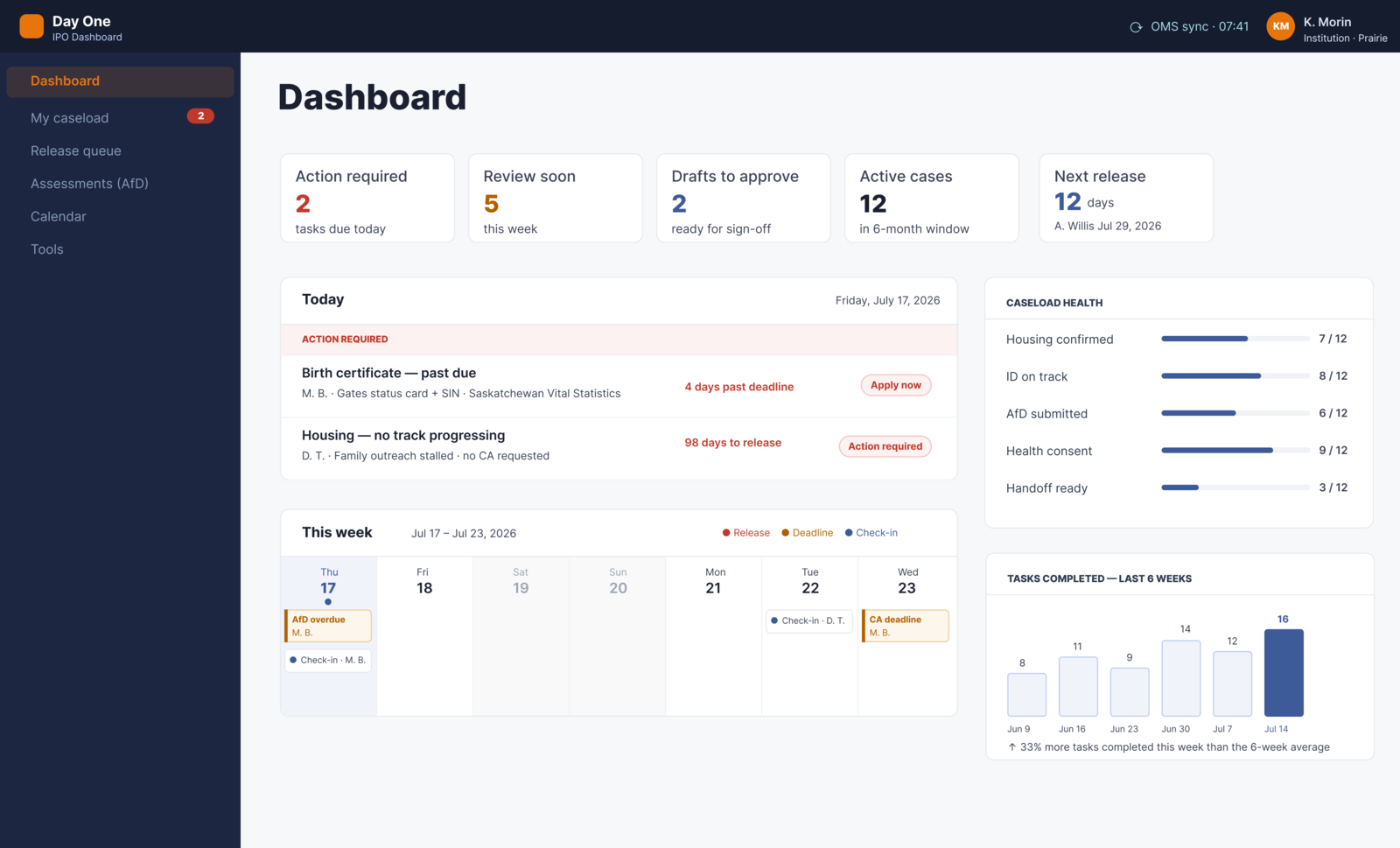
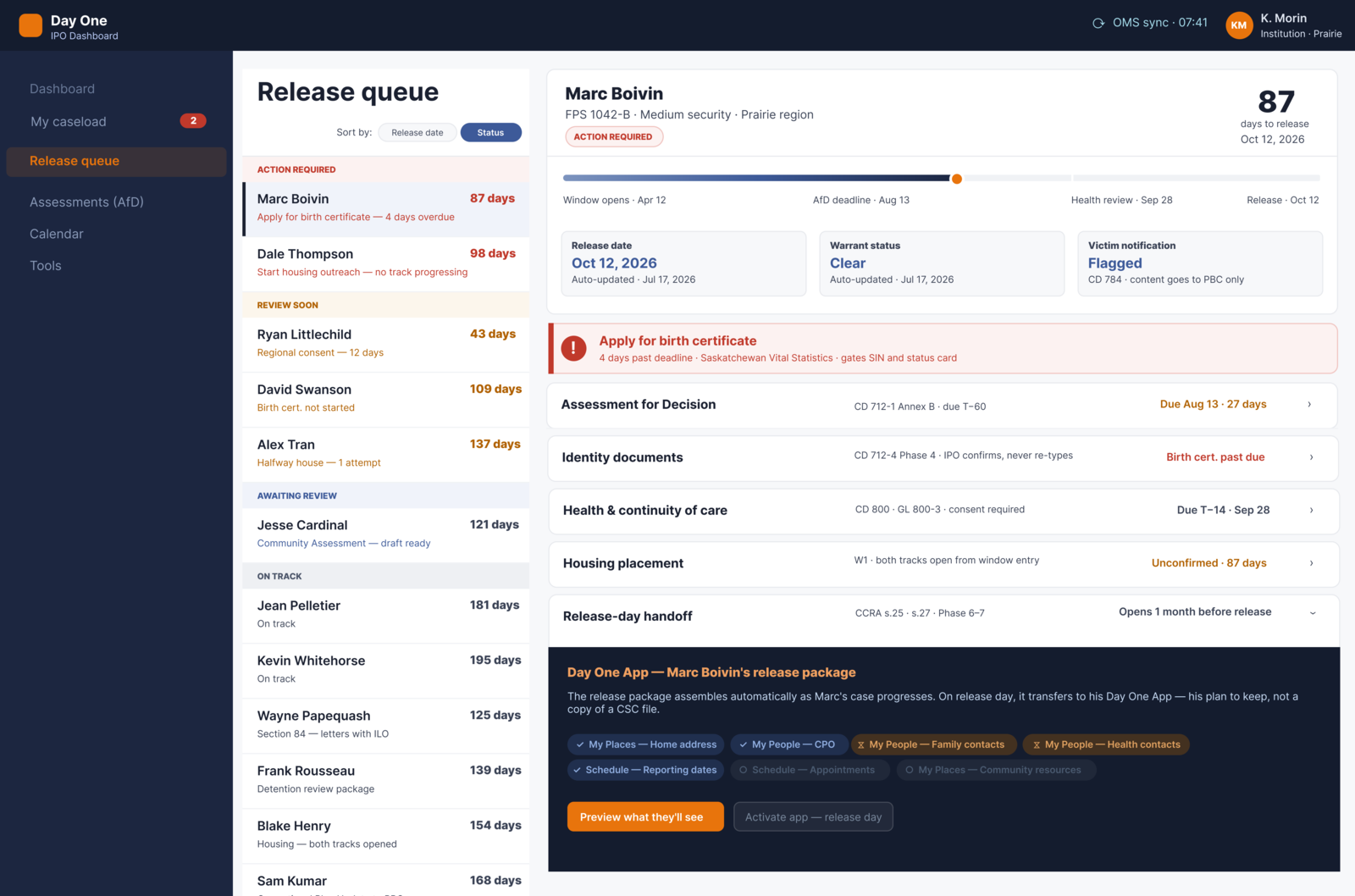
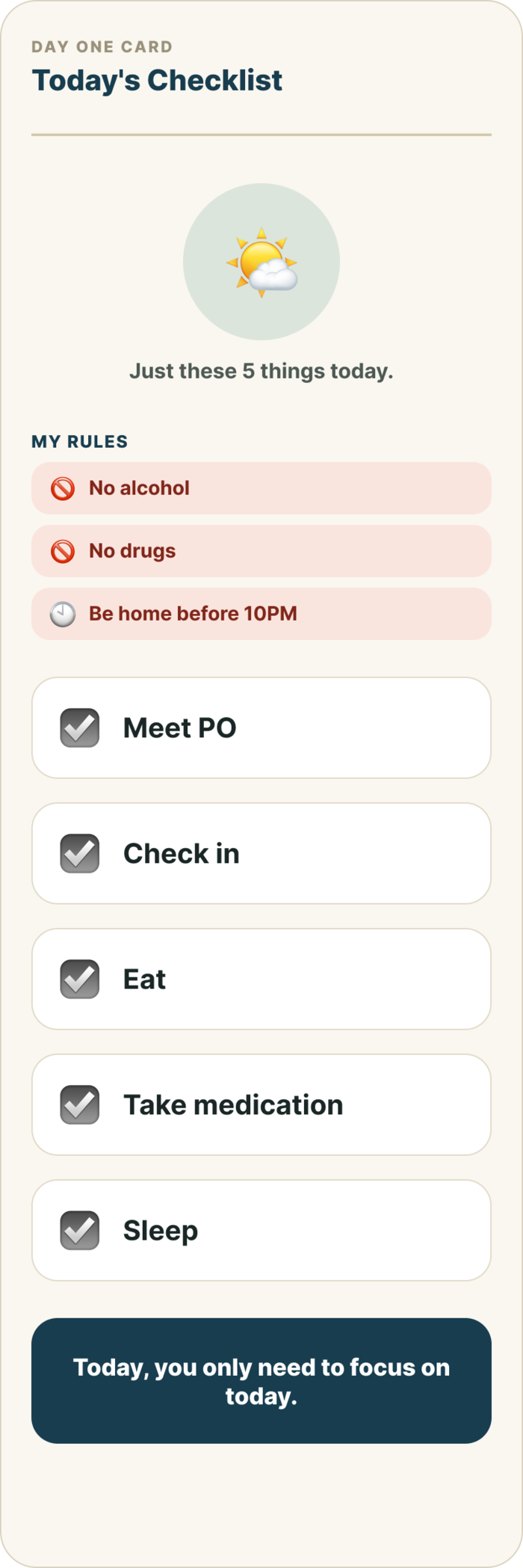
The tool the officer uses, and the object that leaves the building.
The boards above are mine. These six are my teammates', and the convergence is the finding.
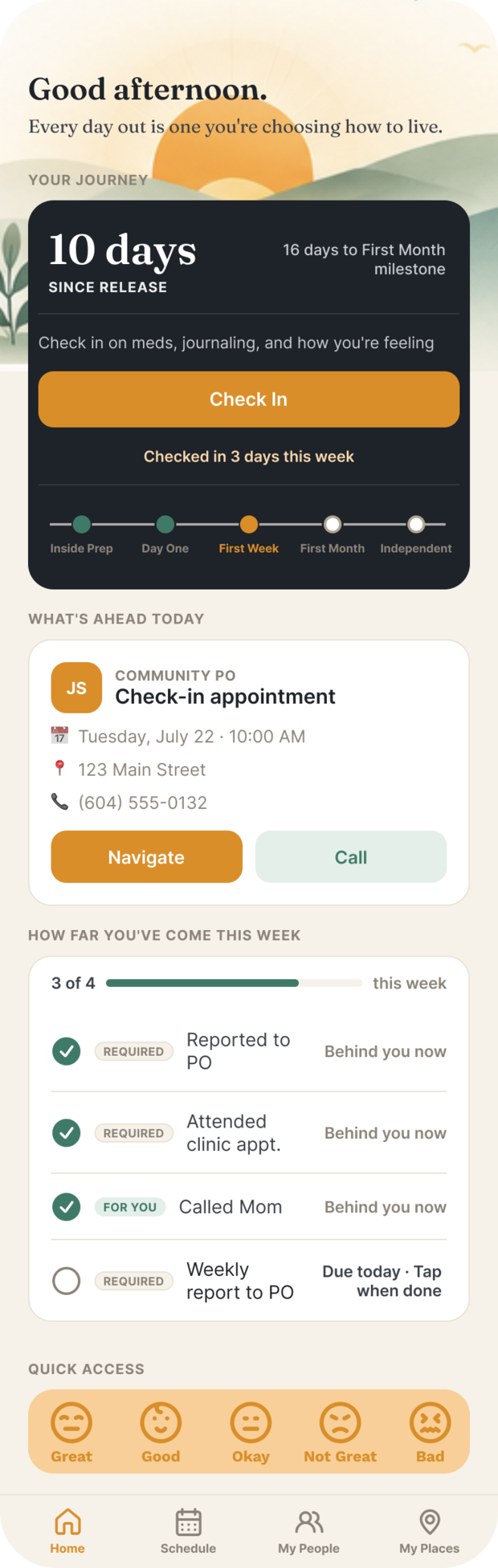
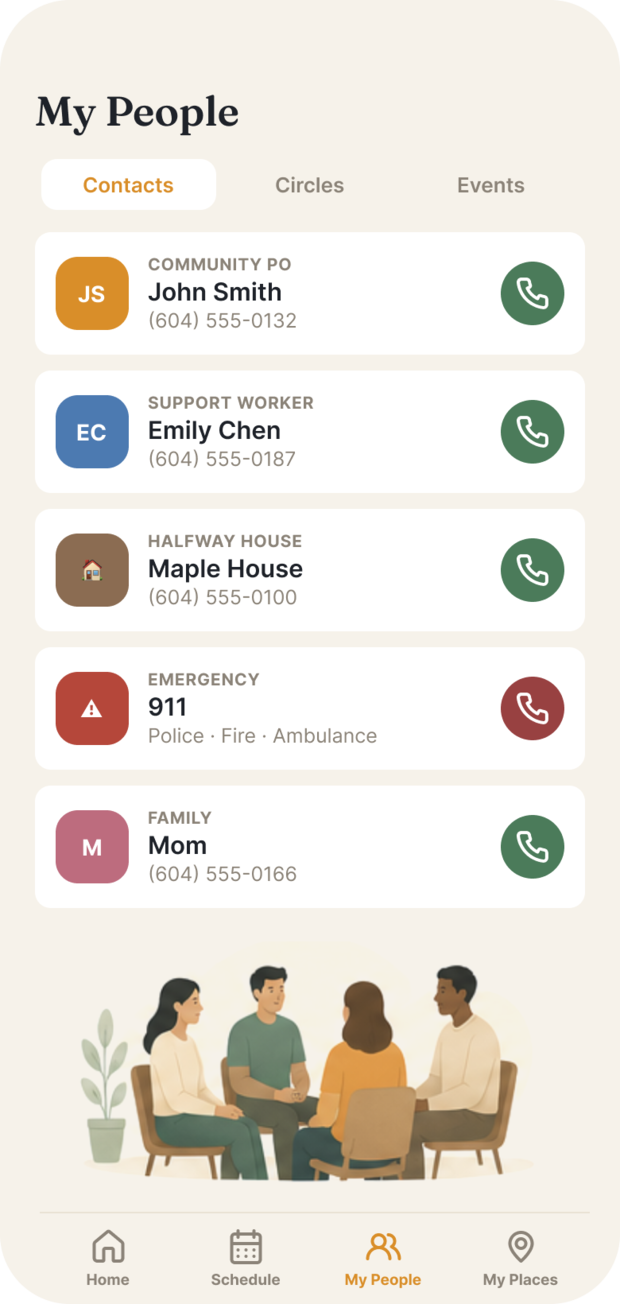
Her five tracks are my five jobs, and neither of us numbered them together. Her app refuses score, streak and leaderboard, which my field map states as a rule. The printed card crosses the wall when nothing digital can, and nobody specified who prints it.
-
-
-
-
-
-


No client, no launch, no usability test.
Nothing here has been operated by a parole officer. Three things survive scrutiny anyway.
Evaluative testing inside a federal security perimeter, on an eight-week timeline, was not achievable once the access had gone on interviews. I would spend it the same way again, and it is why the research here is strong and the testing is not.
The money is the softest: $18.5M against a $3.86B budget is half a percent. The capacity figure is the argument, at 41 officer-years.
The second is the one nobody planned. Three of us worked in parallel with no reconciliation pass and the artifacts agree checkably: her five tracks are my five jobs, and her interface copy is my field map's human-in-the-loop rule, written by someone who never read it.
The third is that it was delivered, and nobody pushed on AI inside a government system or on data privacy, the two objections that had dominated every prior review.
The service blueprint was never built, and that is the finding I would rather leave out.
The plan called for one, and three workstreams started without it. It worked, but three people is small enough to hold one model between them, and on a team of eight the thread would have broken.
The other thing I would change is cheaper. The air gap and the no-phone rule are both in public documents, and either read in week one would have redirected the concept. Before any concept work, write down what the deployment environment physically permits.
And the only iteration cycle that ran on outside input was the afternoon after the pitch. It beat three of our own. The review I ran on my own deck reversed an earlier pass of mine that had prescribed a label on every slide, which is the thing worth keeping: a usability heuristic run over a presentation treats listeners as users of an interface.